1. download the most current version of CallClerk (click here to do this now);
2. exit CallClerk (right click on the CallClerk icon in the systray and select exit); and
3. install the most current version of CallClerk, leaving the option 'Launch CallClerk' checked to run the program when the install completes.
1. download the most current version of CallClerk (click here to do this now);
2. back-up the CallClerk database file on your PC (its location can be found on the Settings - Database window);
Click the [Backup] button on the Settings - Database window to do this.
3. exit CallClerk (right click on the CallClerk icon in the systray and select exit);
4. un-install the old version of CallClerk;
5. install the most current version of CallClerk (which you downloaded in step 1 above); and
6. run CallClerk.
- your data, settings and licensing information will be preserved through the upgrade process
- if you are running several copies of CallClerk over a network you will need to upgrade all your copies
- added an option for call blocking when the caller id name does not contain a letter
- improved caller id name matches caller id number call blocking
- added a feature to blacklist number ranges only when the caller id name is not known
- updated the Directory import from Google feature to align with Google's new way of doing things
(this you can import all your Google contacts, previousily a maximum of only 100 Google contacts could be imported)
- various updates for importing from Outlook
- the Web Page update feature was enhanced to support SFTP file transfers
- the Advanced Run Program parameters settings by example were updated; they were not handling the first character as a quote correctly
- familiar callers now appear with a green background on the CallClerk Popup windows
- now deals with phone service reporting caller id name after caller id number (direct access mode only)
- now sort on display name (as before) or number (new) in Directory and History windows
- correct auto formating of Display Number for the Directory and History windows
- prevented silent detection ... recording stopped loop
- corrected Test Run Program for Custom Callers
- corrected Announcemnet feature for Display/Caller number
- ensure hang-up when the canceling from the Dial Out window
- removed Facebook post functionality
- for longer term supportability, upgraded to make use of Microsoft's dot net framework 4.8
- corrected delays in playing the call blocking SIT and message
- the option to automatically open the CallClerk History window when a new call comes in and the CallClerk Popup Display is not clicked will now ignore blocked callers
- added a button on the History window to skip playing the balance of a message (when a message is playing)
- Del key now a shortcut key for deletes on the Directory and History windows
- updated to align to changes made by Google in support of the Google import feature
- confirmed install on Raspberry Pi running Windows 10 (ARM);
program works well in direct access mode, TAPI does not yet seem to be supported on the Raspberry Pi W10 (ARM) platform
- updated many parts of the program's infrastructure for ongoing compatibility with the most current version of Windows
- added support for TrueCNam.com community based call blocking
- removed support for Whocalled.us community call blocking (as the service went offline)
- added support for PushBullet push notifications to your computer(s) or cell phone(s) running PushBullet
- added command line control to play all unreviewed messages through your computer speakers
- added run program on calls placed by CallClerk
- updated Firefox browser addon for compatibility (July 2018)
- added the ability to remotely dial a call over the network
- added a utility to merge two CallClerk databases
- added the ccRescan program, allowing for remote rescanning of tapi devices
- added setting of 'Offer to blacklist names of newly blocked callers'
- quicker start time for playing of answering machine greeting
- corrected problem with Directory import from Outlook
- other minor tweaks and improvements
- added DTMF signaling to, for example, open your apartment building's lobby door when you call your home phone from your cell phone
- various overall improvements impacting the Directory and History windows, Black and Whitelists, and use over a network
- corrected early hang-up issue related to the pop-up display answer feature
- corrected a Windows XP startup issue
- program now signed with a SHA-2 certificate
- other minor tweaks and improvements
- added dialing prefix and suffix options for directory contacts. For example:
use the prefix to block your caller id info when placing a call, or a suffix to navigate an IVR system
- added option to turn the systray icon background golden when there are unreviewed messages or faxes
- added option to automatically block invalid numbers in North America
- updates addressing Google and Facebook changes for authenticating users
- improved Settings restore process (to include encrypted passwords)
- improved Caller ID handing when not using a TAPI setup - improved remote pickup of messages by phone
- other minor tweaks and improvements
- added the Automatic Number Announcement Circuit (ANAC) feature
i.e. the caller id name and number can now be played back to the caller
- added an option to automatically block a caller when their caller id name matches their caller id number
- added support for recording calls on more types of devices (for example way2call devices)
- added additional filtering on the History window
- a custom font can now be set on Directory and History windows
- improved reporting to whocalled.us
- other minor tweaks and improvements
- added support for multiple monitors
- added click on CallClerk Pop-up Display Picture to manually trigger run programs, reverse lookup, show Outlook Pop-ups, or
start the Answering Machine
- other minor tweaks and improvements
- added the ability to automatically post to your Facebook page when you get or place a call
- added the ability to import to the directory from your Google (Gmail) Contacts list
- added greater flexibility for determining when e-mails are to be sent, and announcements and rings are to be heard
- improvements for distinctive ring identification
- other minor tweaks and improvements
- added call blocking blacklists and whitelists for both caller id name and caller id number
- call blocking blacklists and whitelists for caller id name include wildcard support
- call blocking blacklists and whitelists for caller id number are based on prefixes (such as 800, area code, ...)
- upgraded the Firefox add-on
- upgraded for continued compatibility with Twitter
- improved handling of ghost calls
- other minor tweaks and improvements
- the following new columns were added to the History window:
Message Duration, Fax Pages, Call was Blocked
- added options to filter Caller Type on the Directory window
- added additional silence detection options to end answering machine recordings sooner for some modems
- improved load speed of Windows Application Log window
- other minor tweaks and improvements
- added a new 'Custom' Caller ID Type allowing CallClerk's individual functions to be turned on and off in any combination for a specific caller
- added e-mails notifications will now be queued if you internet connection or smtp mail server is temporarily unavailable
- added custom defined defaults for double clicking on History and Directory entries
- added support for importing phone numbers in New Zealand's phone number format
- improved performance when filtering on Windows Application Log
- improved recognition of tapi modems on some systems
- reduced recording delay after the beep
- corrected problem with entering whocalled.us password
- other minor tweaks and improvements
- added the ability to pass caller information into other programs as if you were typing it in (further documented here)
- added a Chrome extension to allow you to dial from Chrome as you could already do from Internet Explorer and Firefox,
to install the Chrome extension just click here
- added a command line option to allow Outlook Journal entries to be created but not displayed
- added ability to play answering machine via your system's default sound playing software
- added display numbering formatting for the Netherlands
- improved call blocking, calls can now be blocked from any networked PC running CallClerk
- improved installer, future upgrades will no longer require the prior version to first be uninstalled
- improved management of modem sound devices for some systems
- upgraded to use Microsoft's dot net framework version 3.5
- tested on Windows 8 Customer Preview and Release Preview
- other minor tweaks and improvements
- improved support for non-TAPI modems
- added display numbering formatting for the France
- added logic to handle withheld numbers in the UK
- added context sensitive right click menus on the Directory and History windows
- corrected certain windows not being sized correctly on computers with magnified screens
- added view options on the Directory Window to view selective history by either caller id number or display name
- upgraded the Firefox add-on to enable dialing from Firefox
- other minor tweaks and improvements
- added the ability to send a Tweet to your Twitter account when you receive and/or place a call
- added feature to automatically import the contents of a comma separated value (.csv) file into your CallClerk directory
- added context sensitive right click menu on the Directory and History windows
- added option to delete backup files after a specified number of days
- upgrade CallClerk Dial from Internet Explorer and Firefox so that the computer's clipboard remains unchanged
- upgraded the Firefox Add-On to enable dialing from FireFox 4.0 thru FireFox 6.5.11
- other minor tweaks and improvements
- now works with whocalled.us (a community database of known nuisance callers) to help determine if a call should be blocked
- option to ignore ghost calls (calls that only ring once and have no caller id info)
- now translates phone pad letters to international standards
- added system wide hot keys
- added a program restart feature
- added a command line exit feature
- added an immediate dial out feature
- added support for Microsoft Exchange
- added an option to save session log to disk
- corrected a problem loading Outlook contacts
- update registry fix utility to correct common modem problems with Windows 64 bit systems
- updates to the Dial from Internet Explorer and the Windows Application logging features following changes made by Microsoft to Windows
- upgraded the Firefox Add-On to enable dialing from FireFox 3.6
- faster start-up times
- new look to pop-up display window
- improved printing of directory and history
- search feature added to the directory and history windows
- added an option to start faxing on a distinctive ring
- added options to show date, time, and line receiving the call on the pop-up display window
- added an option to suppress e-mails for multiple calls from the same caller over a specific period of time
- added an option to include the phone line identifier of the line receiving the call on the pop-up display window
- allow multiple templates based on caller id name
- added support for transport layer security (TLS) when sending e-mails
- when silence detection is on answering machine to hang-up after 9 seconds of silence
- updates to allow for multiple reverse number look-ups when the default browser is not running
- allow directory templates based on caller id number prefixes - for example handle all 1-800 numbers in the same way
- help file now downloaded on first use
- upgraded the Firefox Add-On to enable dialing from FireFox 3.5
- allow web page updates to n intranet (in addition to existing internet update support)
- support playing and recording of messages on more modems
- confirmed playing and recording functionality on Vista 64 bit
- improved reporting over a network
- faster opening of settings screen
- faster pickups on answering machine
- corrected shutdown problem on some PCs
- allow for command line dialing of a phone number
- updates to better format display number in Italy
- format dates in accordance with Windows regional settings
- fixed problem with recording greetings thru the microphone
- added 'Allow Fax' option
- upgraded the FireFox Add-On to enable dialing from FireFox 3.0
- updates to provide for better caller id reporting in the UK
- updates to better format display number in the UK and in El Salvador
- added an option to pop-up a Microsoft© Outlook© Journal entry when a call is received or placed
- MS Outlook Contact Cards can now automatically pop-up when a call is placed (in addition to when one is received)
- added option to treat all unfamiliar calls as faxes
- added the ability to assign calls reported as unknown by your modem to a directory entry
- added automatic checking for updates
- on new received call, or new placed call, CallClerk will use the Outlook (if it is available) as the default caller name
- block button added to the dialpad window (when it is used to answer unfamiliar calls)
- can change colours on History, Directory and Dial Pad windows
- added 7/10 digit local area code logic
- (in some cases) faster pop-ups over the network
- added more parameters that can be passed when running a program
- option to automatically start recording placed calls
- expanded to work with additional Outlook phone numbers
- added support to allow CallClerk to run on a 64 bit version of Windows
- added support for data/fax and data only modems
- your website can now be updated to include the contents of your CallClerk Directory (along with your history log)
- added reverse number look-up only when caller number is known and caller id name is not
- open associated Outlook contact cards from the CallClerk Directory and History windows
- allow more UK Outlook phone number formats to import into the CallClerk directory
- added support for caller id in Brazil
- prompt for directory name when dialing out and no directory name previously exists
- ability to automatically create and upload a web page containing a list of your callers, messages and faxes
- support for new audio formats which can drastically reduce the size of messages for extracting, e-mailing and web load update
- automatically convert imported wav files into the required format for use as greetings
- increased available speed dial entries from 10 to 20
- ability to change blocked caller message
- support for the Secure Sockets Layer e-mail protocol
- a new e-mail saver option that allows you to optionally only send an e-mail if a fax or message is left
- dial out now supports special prefixes for 1-800, 1-888 ... numbers
- Integration with Firefox, you can now dial a phone number from Firefox
- additional processing to record dropped calls (i.e. rang once and hung up) as unknown callers
- additional options with respect to sending e-mails
improves formatting of e-mails sent as text messages to cell phones
- automatic override of screen saver when the CallClerk display opens to report an incoming call
- Caller ID fix function to correct problems with some TAPI modems
- Improved support for non-TAPI modems
- Improved support for caller id in the United Kingdom
- Install support for Microsoft's version 2 dot net framework (as well as earlier versions)
- Integration with Microsoft Internet Explorer, you can now dial a phone number you've selected on a web page by right clicking on it
- automatically pop-up an Outlook Contact card as a call is received
- import MS Outlook or CSV file contact record information into your CallClerk Directory
- export your CallClerk Directory and History files in CSV format
- a new option to automatically start recording calls answered by CallClerk
- recorded conversations are now saved in history
- faxing of JPG and BMP files is now supported
- re-sizable History, Directory and Session log windows
- a new option to flash keyboard lights when a message or fax is received
- automatic database backup and purge
- corrected problems with the pop-up window not appearing immediately and answering machine detecting silence too soon
- automatically launch other programs, or batch files, when you receive a call
- allow calls with the same Caller ID name to be handle the same way regardless of their Caller ID number
- added support for some TAPI Fax/Data only modems
- fax capabilities
- both incoming and outgoing calls recorded in history log
- run up to three reverse internet look-up searches for one call
- added reverse look-up on name
- import greetings from .wav files
- command line options
- an answering machine with the ability to play a greeting (user defined) and record message
- greetings are defined as default and/or specific to the caller
- the ability to remotely pick up messages
- the ability to e-mail the recorded answering machine message
- along with the auto-hang up play:
a Special Intercept Tone (this is the same tone zapper devices play)
a message that says "please take this number off your calling list"
- speaker phone capabilities, including music on hold
- ability record phone conversations
- music on hold
- options for distinctive ring by caller type (familiar, unfamiliar, and blocked) and individual callers
(Note: the first seven items above require a TAPI compliant modem)
- day and time sensitive e-mail, announcement and ring reporting
- improved network reporting
- the ability to store a shared CallClerk database on a PC not running CallClerk
- Windows 98 is now supported for all functionality excluding voice announcements and Windows Application log reporting
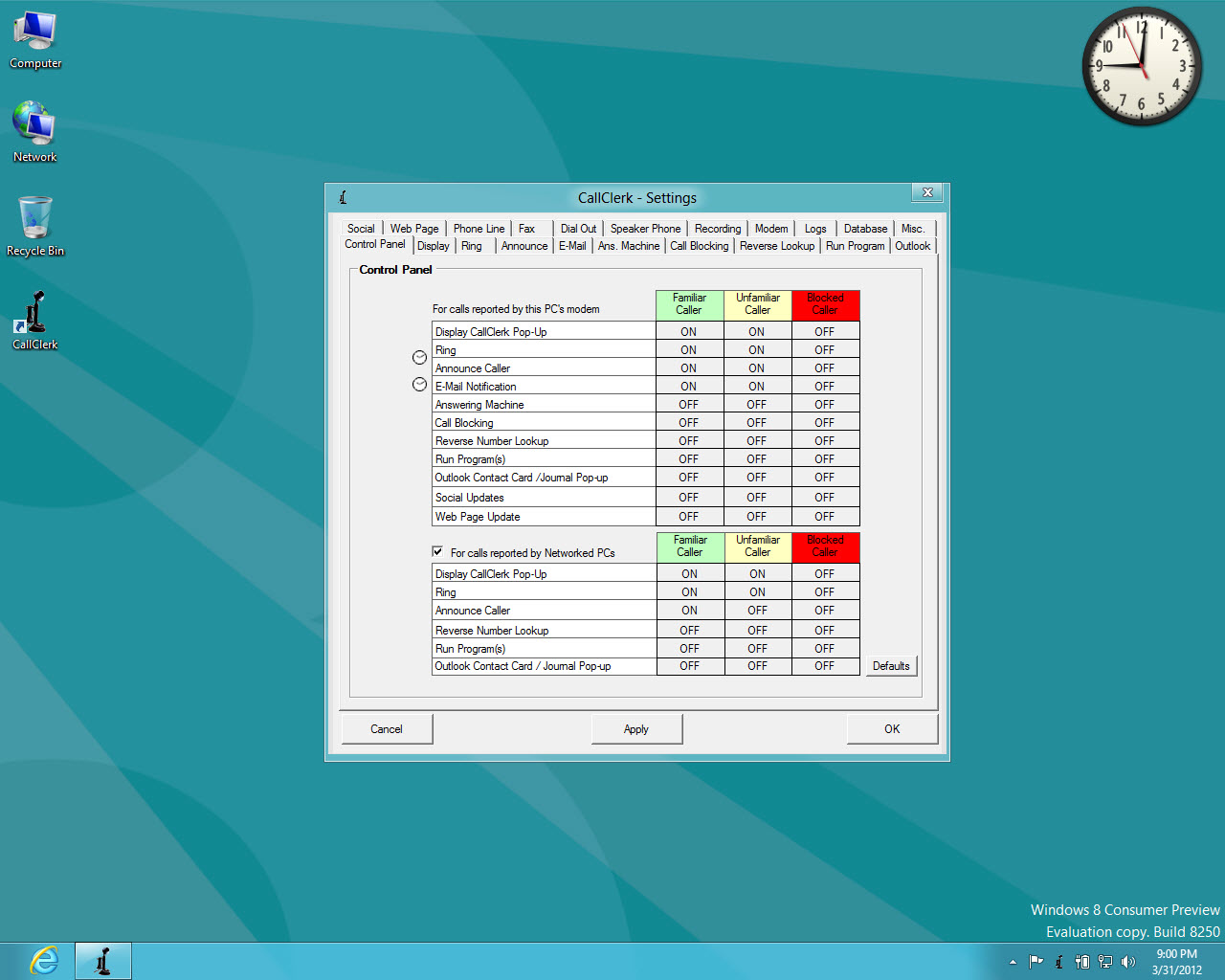
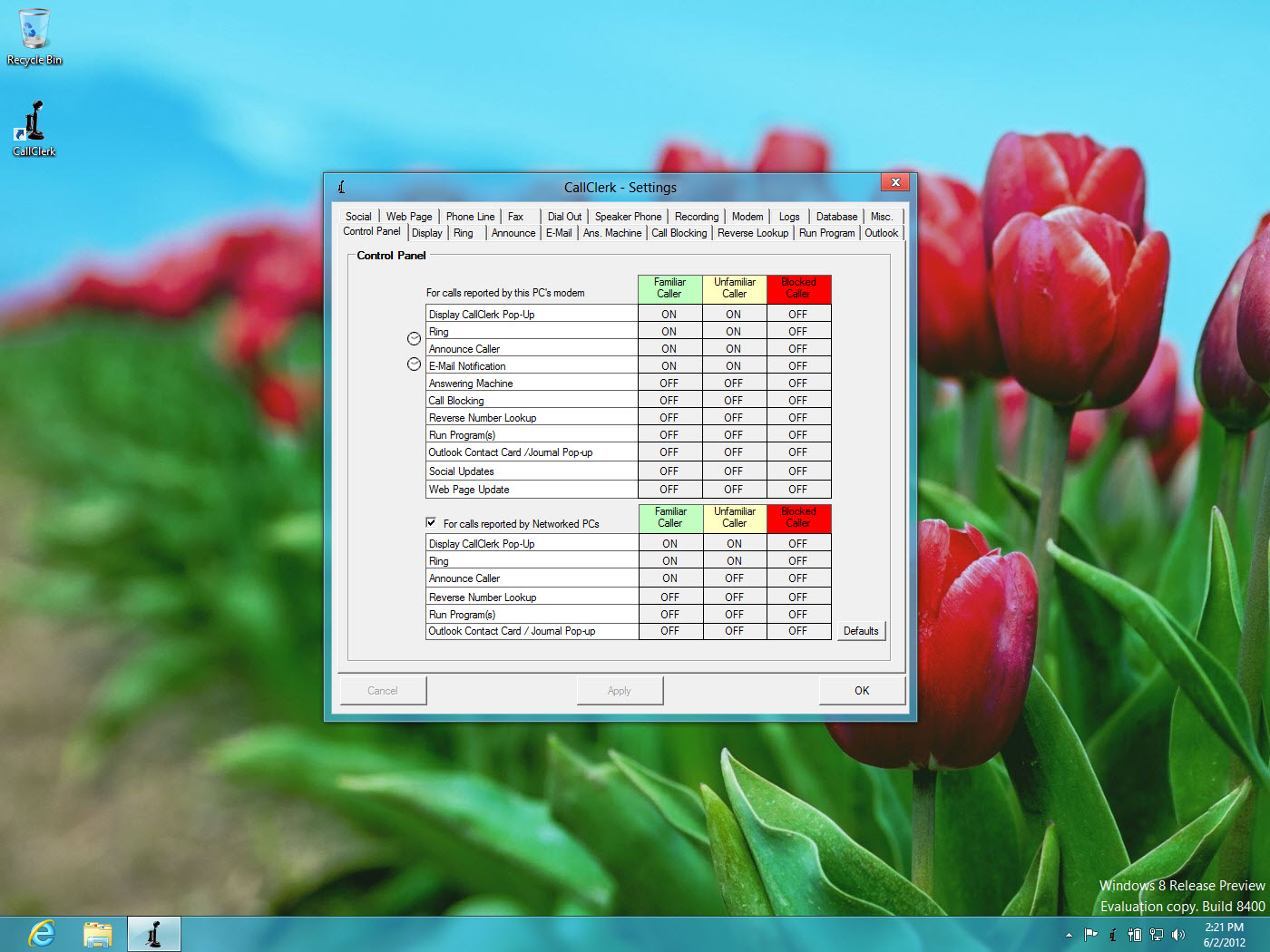
- a centralized 'control panel' in the settings window allows you to more easily see and set, at a high level,
how CallClerk responds to an incoming call
- the ability to tailor options between familiar, unfamiliar and blocked callers
- the ability to tailor options between calls received by your PC and calls reported to your PC over the network
- integrated linking to (free) internet based reverse phone number look-up services
- the sliding display window is now configurable in three sizes - small, medium and large
- the sliding display window can now be set to either slide open or appear immediately from the edges of the screen
- an option to pop-up the history log after a call is received - this lets you see quickly who has called when you return to your PC
(however if you are at your PC this option can be easily overridden by clicking on the sliding display before it closes)
- a new option to allow you to hang up on a call as it is being received for the first time
and then optionally block that caller from that point forward
- the ability to track a phone line identifier in the history log (used for PCs that share a single database over the network)
- displaying of the directory picture for calls reported to your PC over the network is now supported
- a wider selection of e-mail authentication options
- when printing you can now select the printer that you want to print to (previously your default printer was used)
- a variety of other tweaks and improvements
- additional dialing features, including speed dial, redial, last number received dial
- kept dialpad live after dialing
- you can now have a picture, customizable to each individual caller, appear in the sliding display window
- if you are using Windows XP or Windows 2000, you can have a computerized voice announce the name of the caller
- database and preference file backup and restore functionality
| Copyright © 2004 - 2024 Rob Latour. All Rights Reserved. | Tweet | Thanks to OS Templates |